


Insulation for walls – effective heat protection and stable indoor climate
- Reduces heat loss through exterior and interior walls
- Reduces thermal bridges and cold wall surfaces
- High insulation capacity with minimal wall thickness
- Does not absorb moisture and retains its insulating properties over time
- Possibility of lower CO₂ footprint with purRECY
Walls form a large part of a building's climate envelope, which means that the risk of heat loss, thermal bridges and poor comfort particularly arises here. When walls are not insulated correctly, energy consumption increases and it becomes more difficult to achieve a stable room temperature – both in new buildings and during renovations. In addition, the indoor climate is negatively affected because cold wall surfaces can lead to moisture and condensation, which in the worst case creates a risk of mold.
At Dan-iso we produce wall insulation based on PUR and PIR, including Dan-isoRECY, which are produced with recycled materials. With these solutions, the building has both high insulation capacity and a low climate footprint, without compromising on durability and functionality.
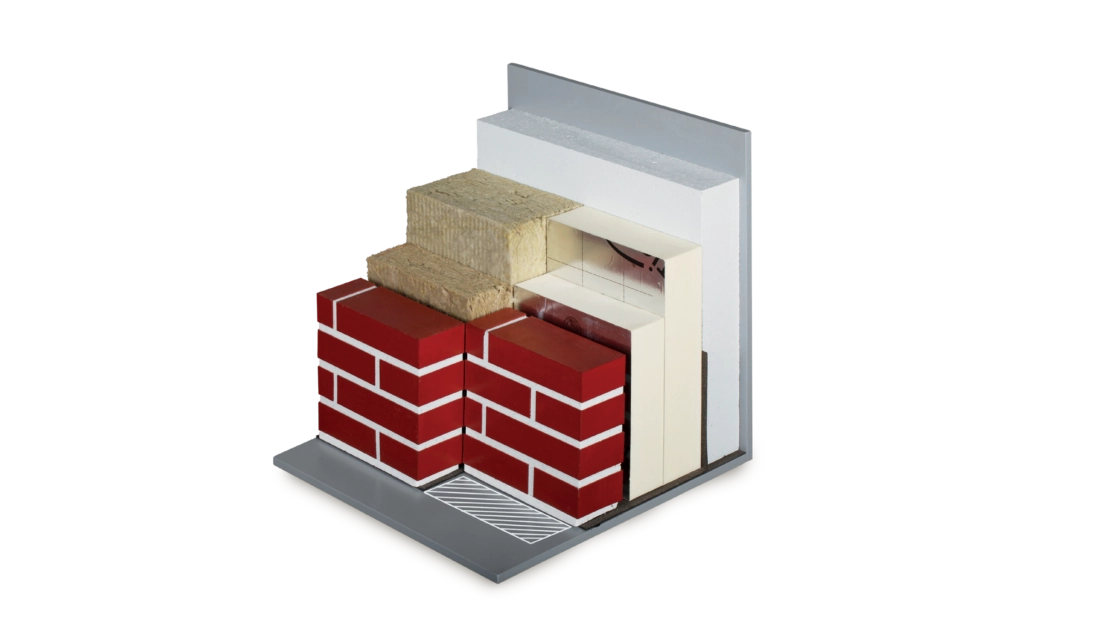
Advantages of PUR and PIR over mineral wool
High insulation capacity with less wall thickness
PUR and PIR insulation differ significantly from traditional insulation materials such as mineral wool, especially when it comes to insulation performance, moisture management and space requirements. While mineral wool requires relatively large thicknesses to achieve the desired insulation, PUR and PIR can deliver the same – or better – insulation with a significantly slimmer wall structure. This makes the materials particularly suitable for both new construction and renovation, where space is often crucial.
Does not absorb moisture – maintained performance over time
Another significant difference is the behavior of the materials towards moisture. PUR and PIR have a closed cell structure and does not absorb moisture, which means that the insulation capacity is maintained over time. Mineral wool, on the other hand, can lose its insulation capacity if the material becomes damp, which can increase the risk of condensation and mold in the wall construction. With PUR/PIR, a more robust and reliable solution is therefore achieved, which contributes to a healthier indoor climate.
Stable and robust construction
In addition, PUR and PIR insulation is dimensionally stable and does not settle over time. This ensures that the wall construction retains its insulating effect throughout the building's lifetime, without the need for readjustment or replacement. At the same time, the risk of thermal bridges, which often occur in joints and transition zones with less stable insulation materials, is reduced.
For projects with a focus on sustainability, dan-isos purRECY is used as an environmentally friendly alternative. purRECY is based on recycled polyurethane and offers the opportunity to reduce the building's CO₂ footprint without compromising on technical properties. This makes PUR/PIR insulation an attractive choice in modern commercial buildings, where energy performance, durability and documentable sustainability are key requirements.
Why proper wall insulation makes a difference
The primary purpose of wall insulation is to prevent heat from leaking out through the structure.
The insulation capacity of walls is measured, among other things, by the lambda value, which indicates the material's ability to resist heat conduction. The lower the λ value, the better the material insulates. An effective insulation material such as PUR/PIR typically has a low λ value, which helps to reduce heat loss in the wall and lowers the building regulations' requirements for U-values.
Furthermore, it is important to consider how the insulation affects moisture transport and accumulation in the wall structure. Materials with high moisture absorption can compromise the overall structure, which means that the choice of insulation material must be made with an eye to both thermal and building physics. PUR and PIR do not absorb moisture and are therefore highly effective.

Let us assist you
Do you have questions or need help? Please do not hesitate to contact us - we look forward to hearing from you.